A resume summary is a brief statement that distills relevant skills, experiences, and achievements tailored specifically to the job you’re applying for. It transcends the basic resume objective, which typically outlines career aspirations and doesn't showcase the candidate's potential value. Instead, a resume summary compiles this information into a compelling narrative, creating a powerful first impression. A well-executed summary highlights your professional identity and significantly increases your chances of securing an interview, making it an indispensable component of any effective resume.
What Is a Resume Summary?
The purpose of a resume summary is to grab the attention of hiring managers by presenting a succinct snapshot of a candidate’s key qualifications, experiences, and accomplishments. This brief description efficiently communicates an applicant's strengths and their relevance to the targeted position, making it easier for recruiters to filter through numerous applications. A strategic resume summary can effectively differentiate a candidate from the competition, particularly in crowded job markets.
Resume summaries are most helpful for job seekers with substantial work histories or specialized skills, as they provide a means to highlight notable achievements. Whereas a resume objective focuses on what the applicant wishes to attain from the job, a well-crafted summary pivots towards what the candidate brings to the employer's table. By effectively showcasing their professional strengths, candidates position themselves advantageously in their ongoing job search efforts.
Resume Summary vs. Objective and Headline
Comprehending the distinctions between a resume summary, objective, and headline is essential for job seekers who wish to make impactful impressions. A resume summary offers a comprehensive overview of relevant professional qualifications, including skills and previous experiences pertinent to the job at hand. It’s especially beneficial for individuals with significant background experience as it allows them to effectively communicate their achievements.
On the other hand, a resume objective focuses on the candidate's career aspirations and goals. While this format may hold value for entry-level applicants or individuals undergoing career transitions, it often places more emphasis on the applicant's desires as opposed to the employer's interests.
A headline, typically a single line positioned at the top of a resume, succinctly summarizes the candidate’s professional identity. While it may grab attention swiftly, it doesn’t provide the depth that a summary does. Overall, utilizing a resume summary is often more advantageous than employing an objective, as it highlights qualifications and links them with the job prospect, thus providing immediate value to potential employers.
Writing a Resume Summary: A Practical Formula
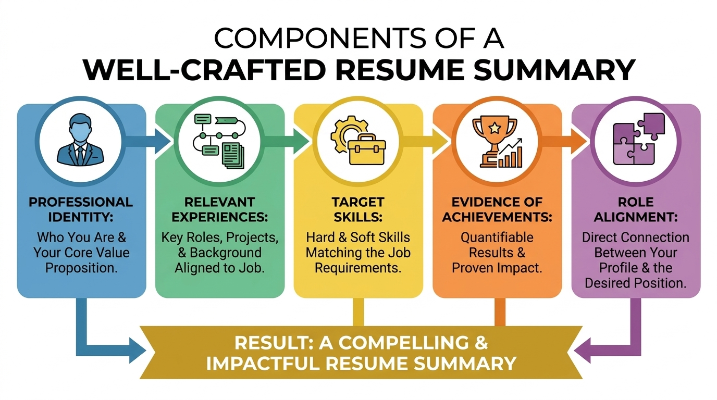
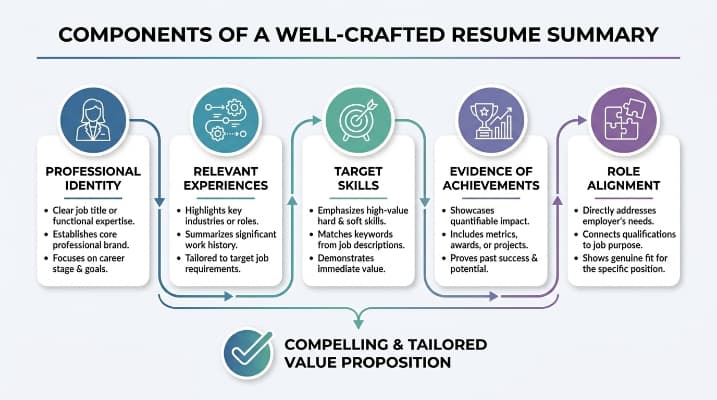
Creating an effective resume summary can set a positive tone for your job application. A practical formula tailored for crafting your summary consists of five vital elements: professional identity, relevant experience, target skills, evidence or achievement, and role alignment. This structured approach ensures that the summary is aligned with the position while prominently displaying your qualifications.
Example
- Professional Identity: Digital Marketing Specialist with over 5 years of experience in online marketing initiatives.
- Relevant Experience: Demonstrated success in elevating social media engagement and executing high-impact campaigns.
- Target Skills: Proficiency in SEO, content creation, and analytical data interpretation.
- Evidence or Achievement: Spearheaded an initiative that increased brand visibility by 30% in a six-month timeframe.
- Role Alignment: Aiming to apply these skills to facilitate growth as a Senior Marketing Manager.
Example Summary: "Dynamic Digital Marketing Specialist with 5+ years of experience increasing brand engagement through effective strategies. Expertise in SEO, content development, and data analysis, having led projects that achieved a 30% visibility boost. Eager to leverage my skills in a Senior Marketing Manager role to drive strategic growth."
This framework not only provides a strong foundation for an impactful summary but also aligns closely with the job description requirements, ensuring that your resume commands attention from hiring managers.
Examples by Career Stage and Experience Level
Entry-Level Candidates
"Motivated recent Business Administration graduate with leadership experience through student organizations and internships. Eager to contribute analytical skills within a thriving corporate environment, ensuring collaborative success while enhancing professional development."
Students
"Ambitious college student pursuing a Computer Science degree, with hands-on experience from coding boot camps and personal projects. Proficient in Python and Java. Seeking internship opportunities to apply technical skills and contribute innovative ideas."
Experienced Professionals
"Results-oriented marketing professional with over 5 years of experience executing high-impact campaigns across various digital channels. Well-versed in strategic content creation and adept at utilizing data analytics to enhance brand engagement."
Career Changers
"Dynamic sales expert with a proven record of leveraging customer insights to increase sales by 30%. Ready to transition skills into digital marketing, applying creativity and consumer understanding to develop impactful online strategies."
Returning Workers
"Dedicated project manager returning to the workforce after a five-year career break. Experienced in IT project management, with robust organizational skills. Prepared to utilize updated technological competences to lead successful projects within a collaborative environment."
Managers
"Results-driven project manager boasting over 10 years of experience in the tech sector. Expert in coordinating cross-functional teams to deliver innovative software solutions on schedule and within financial parameters."
Executives
"Visionary executive with an extensive history in strategic planning and organizational transformation. Over 15 years of leadership experience enhancing profitability and operational efficacy in Fortune 500 enterprises."
Technical Roles
"Accomplished software engineer with 7 years of full-stack development experience. Proficient in contemporary programming languages and frameworks, including React and Node.js. Looking forward to contributing to innovative projects enhancing user experiences."
Customer-Facing Roles
"Enthusiastic customer service representative known for efficiently addressing inquiries and elevating customer satisfaction. Strong interpersonal skills and a proven ability to manage high-volume queries with excellence."
Resume Examples for Different Project Management Career Paths
Different professional contexts influence how resume summaries can be structured and articulated. For example, a recent graduate aiming for an entry-level marketing job might frame their summary as:
"Eager marketing graduate equipped with internship experience in digital strategies, focusing on social media management, seeking to apply skills in content creation to elevate brand awareness."
This summary emphasizes education alongside relevant internship experience, significant for entry-level candidates. The term “eager” conveys enthusiasm, which is appealing to employers.
Conversely, a seasoned project manager in the tech industry might use a more authoritative tone:
"Results-driven project manager with a decade of experience leading cross-functional teams to accelerate product development on time and within budget."
Here, descriptors like “results-driven” and “decade of experience” immediately establish credibility and leadership prowess, aligning with the expectations of organizations searching for experienced professionals.
Additionally, a career changer aiming for UX design could state:
"Professional with a strong foundation in graphic design and user-focused problem-solving seeking transition into UX design to craft impactful user experiences through innovative approaches."
Highlighting transferable skills is crucial within this summary, clearly connecting previous experiences to new career aspirations and showing adaptability. Each tailored summary serves as an example of the importance of aligning language with the job description, ultimately increasing the likelihood of catching the hiring manager’s eye.
Resume Before-and-After Examples: Turning Experience Into Stronger Applications
Weak Summary:
"Highly motivated and experienced professional looking for a challenging position."
Strong Rewrite:
"Dynamic marketing specialist with over five years of experience driving revenue growth through targeted campaigns and data-driven strategies."
Analysis:
The weak summary lacks specificity and fails to communicate the candidate's expertise or achievements. In contrast, the strong rewrite incorporates specific industry terminology and quantifies experience, enhancing credibility and demonstrating the candidate’s value effectively.
Weak Summary:
"I have worked in IT for several years and am looking for a new opportunity."
Strong Rewrite:
"Innovative IT professional proficient in implementing solutions that enhance operational efficiency and improve user satisfaction across diverse projects."
Analysis:
This weak summary does not showcase clear accomplishments or skills. The strong rewrite stands out by emphasizing innovation and tangible performance metrics that validate the candidate’s contributions in prior roles, engaging potential employers while reflecting strong alignment with job requirements.
How to Tailor Your Resume to a Job Description
When customizing your resume summary to align with a specific job description, consider the following key aspects:
- Clarity:
- Use clear, straightforward language to transparently communicate your qualifications in relation to the job.
- Concise Length:
- Strive for 3-5 sentences to keep it brief yet informative, maintaining the reader's focus.
- Relevant Jargon:
- Integrate industry-specific keywords from the job posting to showcase familiarity with the role.
- Grammar and Style:
- Thoroughly check for spelling and grammatical errors while maintaining a professional tone.
- Factual Verification:
- Confirm that all statements are accurate and can be substantiated with relevant experience or evidence.
Adhering to this checklist can enhance your resume's overall effectiveness and bolster your chances of securing an interview.
Common Mistakes and Truthfulness Checks
Crafting an impactful resume summary can prove challenging; candidates frequently fall into common pitfalls. One of the most prevalent mistakes involves the use of vague language, which can dilute the impact of personal accomplishments. Instead, concentrate on specific achievements and quantify them when feasible. Another common error is neglecting to tailor the summary to the job description. Generic summaries seldom capture employer interest.
Additionally, many applicants may exaggerate or misrepresent their skills, which can lead to disastrous consequences. Honesty is not only an ethical obligation but also essential for establishing trust with prospective employers. Use clear metrics or examples when discussing achievements, without fabricating experiences. This honest approach not only paints an accurate picture but also lays the groundwork for trustworthiness in future conversations. By steering clear of these traps and emphasizing truthfulness, candidates can craft compelling summaries that effectively elucidate their strengths.
Final Tips for Writing an Effective Resume Summary
A strong resume summary helps employers quickly understand your professional background, relevant skills, and career goals. The most effective summaries focus on specific experiences, measurable contributions, and abilities that align with the position being pursued.
Rather than using a generic statement, tailor your summary to each job opportunity by highlighting the skills and experiences that match the employer’s requirements. Whether you are entering a new field, changing careers, or advancing in your current profession, a well-written summary can provide a clear introduction to your qualifications.
By reviewing your experience, identifying your strongest skills, and adjusting your resume for each role, you can create a more focused and professional representation of your career background.